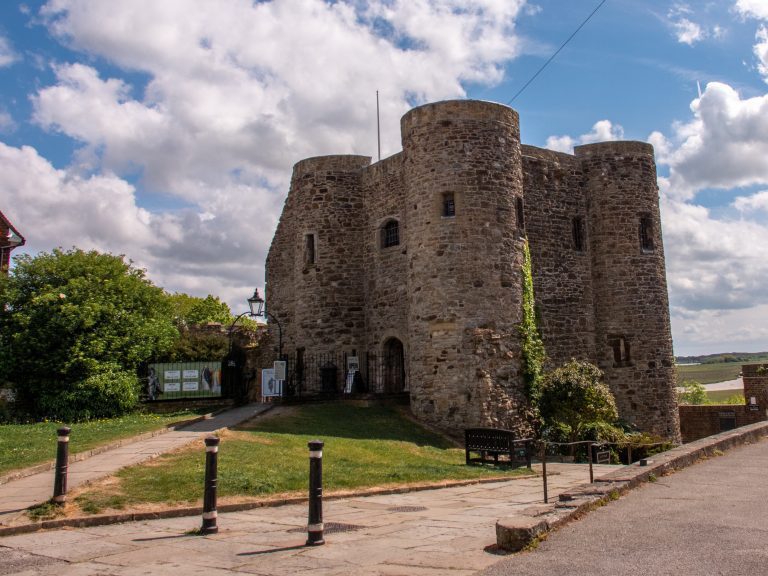

— 800 years of history
The story of Rye Castle
The Ypres Tower sits on a sandstone hill in the middle of Rye. It has seen many changes over the centuries and has been a central part of most of them. It has been a fortress, a family home, a courtroom, a prison, a morgue, and now a wonderful little museum. Few buildings have quite so many stories to tell.
A town worth defending
Rye once jutted out into the sea, its hilltop guarding one of the busiest harbours in all of England. Riches like that needed protecting, and the town has been fortified remarkably early in its story. Back in 1216, Prince Louis of France swept into Rye Castle during his invasion of England and helped himself to everything inside — though nothing of that very first stronghold survives today.
The tower you’ll see now is traditionally dated to 1249, when Henry III ordered Rye’s defences strengthened against the ever-present threat of French raids. In those days it was known as Baddings Tower. Some experts, including Historic England, believe it may actually date from the 1300s, when Rye’s mighty stone town walls went up. Either way, you’re looking at one of the oldest buildings in town and a rare survivor of medieval England
Fire, war and survival
The 14th century was no time for the faint-hearted on this coast. As the Hundred Years War raged, French raiders sailed in during 1377 and burned Rye almost to the ground. Only a handful of stone buildings came through the flames — and this tower was one of them. With the town’s court hall in ashes, the tower stepped up to become a meeting place for Rye’s Corporation.
How a castle got its Flemish name
By 1430 the fighting had crossed the Channel and Rye needed money to rebuild. So the town struck a deal and sold the castle to John de Iprys, a wealthy cloth merchant whose family hailed from Ypres in Flanders. He made the old fortress his home for just 22 years or so — but his name stuck fast. Locals have called it the Ypres Tower ever since, and by long tradition you’ll hear it pronounced “Wipers”. Try it for yourself.
Five centuries behind bars
In 1494 the tower returned to the town’s hands and soon took on its grimmest role of all. For roughly 400 years it served as Rye’s gaol and court hall, and conditions were brutal: men, women and children locked up together in the turret chambers, sleeping on straw, held in leg irons and fed little more than bread, beer and water.
Its most infamous guest arrived in 1743. John Breads, a local butcher with a grudge against the Mayor of Rye, set out one dark night to commit murder — but stabbed the wrong man, killing the mayor’s brother-in-law Allen Grebell instead. Breads was held here, tried, hanged, and his body left on display in an iron gibbet for more than twenty years. Brave visitors can still meet a replica gibbet today, skeleton and all.
Elizabeth Fry and the Women's Tower
Change finally arrived in the 1830s, when the celebrated prison reformer Elizabeth Fry visited Rye in 1835 and was horrified by what she found. Her campaigning helped bring about the Women’s Tower in 1837 — a separate two-storey block where female prisoners could at last be held apart from the men.
The exercise yard between the two towers has been lovingly recreated as a medieval herb garden, planted with the very herbs people once used for cooking, healing and housework. It’s a peaceful, fragrant spot with a fascinatingly dark past.
The prison closed for good in 1891, when a smart new police station opened in town, and the old tower spent a spell as Rye’s mortuary before its next chapter began.
War damage and a fresh start
The tower’s final battle came in 1942, when a German air raid destroyed the roofs of both the Ypres Tower and the Women’s Tower. Repairs followed in the early 1950s, and in 1954 the building threw open its doors as Rye Castle Museum. The Women’s Tower was beautifully renovated in 2013, so today you can step right inside the Victorian cells and hear the stories of the women once held there.
What you'll discover inside
This Grade I listed building and Scheduled Monument is cared for by the Rye Museum Association, a local charity, and it’s brimming with treasures. Inside you’ll find medieval pottery, smuggling relics, armour and weapons, the gripping tale of the prison years — and even an original medieval garderobe (that’s a loo, and yes, you’re allowed to peer in).
Don’t miss the Gun Garden just below the tower, where old cannons still stand guard over Romney Marsh. On a clear day you can pick out Camber Castle in the distance and trace a coastline that has shifted dramatically since the sea once lapped at the foot of Rye’s hill.
And there’s more. A short stroll away on East Street you’ll find our sister site, the second half of Rye Castle Museum, packed with gems from the town’s past — including the Rye fire engine of 1745 and the dazzling regalia of the Cinque Ports.